
Tuesday, February 28, 2012

Virtual Worlds: Blog Seven-The Secret Life of Gold Farmers

Rich Thurman looks like your average American citizen. He is thirty years old, has a wife, and two young children. Rich also has a solid job working as a software engineer. He even plays video games. Yet many people would not know that Rich secretly has been running a successful business from the seemingly pointless games he plays.
Rich used to play Ultima Online, a popular MMO. “I played it two years straight, right from the start of the game back in '97,” Rich jokingly says, “until my wife started complaining that the only way she could socialize with me was to play UO.” Yet after a friend sold his account for a thousand dollars, Rich got to thinking. He realized that people would pay real-world money for online commodities. Rich became the leader of EasyUO Cartel, a gold farming company.
What exactly is gold farming? Gold Farming is the real-world sale of virtual goods and services produced in online games. Gold farming is a controversial subject in virtual worlds because many players feel as though it is cheating to buy from a gold farmer. Some games even ban gold farming or control bots/macroing, which is when characters are controlled by a code that makes them do repetitive tasks to gather items that can be sold or traded for in-game currency. There are three main things that gold farmers do, sell in-game currency, power-leveling and selling in-game items. In Rich’s case, he was more into selling in-game currency. Yet there is no way that Rich could make enough gold to profit on alone. Using his coding skills, Rich was able to control multiple bots. Yet gold farming is not as simple as just setting up a bot, in most virtual worlds players who bot get their accounts banned. Game moderators will ask players suspected of being a bot are asked questions that only a real user could answer (like the color of something). So Rich had to set up a system that allowed him to be notified when a macro was being questioned by a GM (game moderator) so he would be able to answer.
            Yet Rich is not the only one with a gold farming business. Lee Cadwell is another big gold farmer in the Ultima Online community. He is the owner of Blacksnow and Ingotdude, the Cartels biggest competition when it comes to gold farming. Lee and Rich were brought together by a common foe. Both men were ripped off when they tried to purchase gold from the same Ebay seller. Lee showed interest in merging Blacksnow and the Cartel and the two exchanged conversations about going through with it.
After many long discussions, it seemed that both Rich and Lee had reached the agreement that they would join forces to become the leading power in Ultima Online gold farming. When suddenly, some of their accounts were banned. Lee became accusatory of Rich, claiming that he must have something to do with the account bans. When Rich attempted to calm Lee down, claiming that all of his accounts were also banned, but Lee lost it during an IM conversation with Rich.
[Lee goes by the name “Destiny” while in chats]
"Destiny: ok either you are lying to me about who has exevents, you are lying to me about what you guys are doing with it or there is something out there that can do the exact same thing. on eof those three are the possible answers and i am beginning to feel like i am being played and when it comes to my rent and my food being paid for i dont like to be played.”
“Destiny: no you motherfuckers are in for it, its fucking on."
Ever since that IM chat, Lee has sworn to get back at Rich. Rich tells us, "Lee is putting too much heat on me right now. Every bot I try to put in action, he finds it and gets it banned. I'm going to have to lay low for a while till things simmer down a little. And start looking for new bugs to work. With all this exposure going on, all the old ones are getting patched left and right by the designers. But it's always like this. Every time OSI goes in and fixes things, they pop a few stitches somewhere else. And you just gotta go and find them."
Will Lee and Rich ever settle their differences and work together like they had planned? Most likely not. So then what will happen with this war? Will the Cartel find a new bug that will allow them to enter the system unnoticed? Only time will tell and we will keep you updated as these events unfold.

Sunday, February 19, 2012

Virtual Worlds: Blog Six-Pool's Closed

        Our virtual world class, we read an article called And the Ringleaders Were Banned: An Examination of Protest in Virtual Worlds by Bridget Blodgett. We focused on protests that have happened within virtual worlds. Ultima Online, World of Warcraft, Second Life, Eve Online and even Habbo Hotel are just a few virtual worlds that have experienced large in-world protests. In her article, Blodgett discusses how protests change when they are moved into a virtual space. Blodgett uses a model to analyze how technology and virtual worlds causes different protest methods to be necessary. In her model Blodgett explains the four concepts that make up the model: the degree of virtualization, legality, cultural homogeneity and limitations of participation. The degree of virtualization is “a simple percentage of the amount of organization and participation that was achieved offline or virtually”. This is a pretty simple point. Next, legality is “a measurement of how legal the actions of the protests were both in planning a protest and holding it”. Often, protests that bridge the online/offline gap break the law, while purely online protests do not. The third point is cultural homogeneity. Cultural homogeneity is “a measure of how more similar individuals within the protest are to each other in regards to their cultural views and identity”. And the final point is the limitations on participation. The limitation on participation is “a measure of if and how individuals are prevented from participation in the protest”. These are all unique parts of the different aspects of a virtual protest that are often needed for the protest to have that framework.
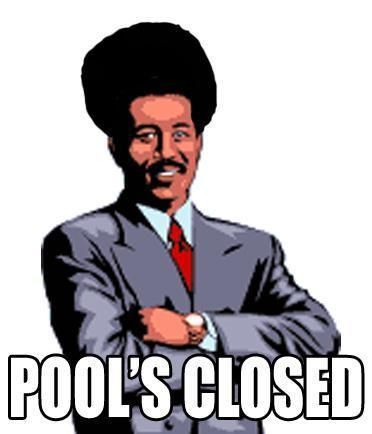
One of the more interesting/amusing protests that occurred were the Habbo Hotel raids. Every single year since 2006 on July 12th, hundreds of black avatars donning afros and gray suits flood Habbo. This all began on the /b/ thread of 4chan back in 2005. Some /b/tards heard a rumor that some of the Habbo moderators were racist and banning black skinned avatars without reason. To protest, the group went in-world with avatars wearing gray suits and afros. They would block the entrances of the pools and claim that “Pools closed” to all those who entered. It was one of the biggest raids of its time.
            What does this protest have to do with Blodgett’s virtual protest model? All of the protesters participated online. There are a couple instances of people dressing as the black avatar symbol at conventions but other than that it has no real life influences. I do not believe that this protest continued outside of 4chan and Habbo. Also this raid was completely legal. There are no laws in the Habbo EULA that ban avatars to wear a gray suit and afro. Also the fact that the game did not allow players to walk through each other was a design flaw (which was later changed). As far as cultural homogeneity goes, protesters were from all backgrounds. On the final note concerning limitations on participation, I do not think that individuals were prevented from protesting. This protest meets all of the parameters to fit into Blodgett’s model for online protests.

Sunday, February 12, 2012

Virtual Worlds: Blog Five-User Created Content


            After playing Lord of the Rings online for a few weeks, our class moved onto a new game called Second Life. Second Life is a cool game where you can create almost anything out of basic shapes and actually make real world money off of your creations. Our first official Second Life reading was Escaping the Gilded Cage: User-Created Content and Building the Metaverse by Cory Ondrejka.Ondrejka talks about the importance of user created content for virtual worlds. He claims that by having more user created content in world, we are moving closer to a metaverse (which is basically a place where people can effectively connect and be productive). Many games have come close to this metaverse but no one has been able to achieve it yet. Ondrejka thinks that Second Life is the closest virtual world to being a metaverse due to the allowance of user created content in games. Because people can create rather than craft (crafting is not creating, rather just helping your player get achievements accomplished) in game, "this allows users to create iteratively and interactively, while sharing the act of creation with other users" thus creating a closer community. Ondrejka says that because so many Second Life players contribute to creating their world it makes a strong and diverse social network.
            I have actually played Second Life before so this was not my first time building objects in game. So when we played in class it was a refresher for me. But even though I had played before it took me a bit of playing around to figure out how to create shapes properly (along with doing tasks like coloring, texturing and connecting shapes). It is a lot of fun to create things in Second Life.
I actually ended up creating a small doghouse-like structure as my object. I chose to create a doghouse because my avatar at the time was a German Sheppard so I thought that it would be funny to create a house for him.
For the creation of the doghouse, I used the basic prism tools to create the house. I used the cube and cylinder tool to do most of my work. I created a base, and three back wall panels of the doghouse by stretching out the cube prim to make a floor and walls. I then used stretched cylinders to create columns for the front of the doghouse. I finally finished the house by placing a large pyramid shaped roof over the structure. As for textures, I just used the basic textures that came in my texture pack. I didn’t really feel the need to go out and buy new textures because the ones that I already had were fine for what I was building.
While some people get help building things, I did not end up collaborating with anyone on making my doghouse because I didn’t feel the need to. I was just building something for fun, nothing too big that I would need someone’s help with.
             I think that the user created content really does make Second Life different from most if not all of the games that I have played. Having all of creative creations in world really does make it a different experience. Creating houses, automobiles, and even clothing makes the in game experience awesome. Even though I did not have help creating my doghouse I am pretty sure that if I was creating something bigger, I could get the help I needed considering most of the people I met in-game were quite helpful. If I play Second Life more I feel as though Ondrejka’s argument would apply more than it does to me now.