Wednesday, May 9, 2012

Interarts: Copyright and Free Culture


            In Lawrene Lessig’s article, The Failures of Fair Use and the Future of Free Culture discusses the issue about law regulations in creative processes. In the first two sentences, Lessig lays out the reality of the matter, “"the law regulates creative process. It always has and always will”. (Lessig, 42) It does not matter how amazing your art is, if it is located on something that “shouldn’t” be turned into art or if you use (for example) sexually explicit material you may get in trouble. But out of all the regulations that have been created, copyright is the most well known and more recently has been used to stop artists from creating works using other known artists works. A good, modern example of this is “raised about DJ Danger Mouse’s Gery Album, created by mixing Jay-Z’s Black Album with the Beatles’ White Album.” (Lessig, 51) Lessig goes on to tell us that Jay-Z actually had no issue with the remix being made but the Beatles had an issue (the EMI even threatened to sue anyone who even so much as distributed the Grey Album). There are countless examples of artists being sued by large companies for using so much as a sound clip from a movie in a creative artwork. A long time ago, copyright only used to be in place until the creators death, then the work was released into creative commons. This issue of increased copyright is actually going to hurt our society and it’s creativity in the long run. Due of the recent increase of Internet use, copyright laws have been heavily enforced all over the country and for the majority of the time big companies win lawsuits because of how vague copyright issues are. If nothing is done soon, our countries creativity may be stifled.
            An example of a place that has realized the negative effects copyright has on the creative process is Japan. This is why the highly popular art form called doujinshi is allowed to thrive. Doujinshi is quite simply the Japanese word for self-published works (like novels or mangas). They are generally fan made mangas (the Japanese form of comic books) that usually use already created characters (like Naruto from Naruto or Luffy from One Piece). Doujinshi authors write entirely new stories or adventures for characters to go on. You would think that Japan would be upset over these mangas but they actually almost never are. Many real manga artists do not mind if fans make doujinshis because of a few main reasons. One being that these upcoming artists can get practice drawing in either a certain authors style until they find an art style that they like. And two, doujinshis helps new artists learn how to become good manga writers and once they get good will usually go to the publishing companies to create their own stories (which will bring in more money for the publishers). And three, doujinshis actually bring in more profit for the artist who originally created doujinshi characters because many times readers will go and read the original work. Unlike America, Japan has realized that it is beneficial to let some copyright regulations go unenforced for the betterment of their societies creativity and business.
            The United States should realize that enforcing copyright all of the time often stifles creativity. When you think about it, our culture was brought up on the borrowing and use of other people’s ideas (which is what many people would call “piracy”). Steve Jobs and Bill Gates both took different people’s ideas (none of which were credited) during the creating of both Apple and Microsoft computers. Even childhood favorite movies, like basically any Disney movie, would never have been made if piracy and copy right laws were in place because Disney would not have been allowed to put his own twist on a classic Grimm or common story tale. As long as artists are not taking other artist’s work, claiming it as their own and making money off of it (like if someone traced a famous drawing and sold it off as their own original creation) they should be allowed to used other, existing sources to either get new ideas or perspectives or inspiration. For example, there are many artists who take music and noise clips from My Little Pony: Friendship is Magic to create cool songs. Most of these artists make no money off of any of their music because they allow free downloads rather than forcing listeners to pay for the track. If Hasbro wanted to, they could go after these brony musicians and sue them for using sound or song clips from their shows. Yet, they choose not too because, like in Japan, Hasbro does not mind people using their products in art as long as money isn’t being made off of it or the artist is claiming 100% ownership of the music.

It is up to the artists and society itself to fight for the change of these laws. Lawrence Lessig puts it best when he says; "we have entered an age in which the right of artists to create freely must again be won". (Lessig, 53) If no one puts up a fight, then slowly our societies creativity will crumble. 

Tuesday, May 1, 2012

Interarts: Transmedia Storytelling


           This week we read weblogs from Henry Jenkins. Henry Jenkins is a well renowned media scholar who has written multiple books about new media. The most relevant readings we read by Jenkins were about convergence culture and transmedia storytelling. But what exactly is transmedia story telling? “Transmedia storytelling represents a process where integral elements of a fiction get dispersed systematically across multiple delivery channels for the purpose of creating a unified and coordinated entertainment experience” (Jenkins). This means that in a transmedia story, the plot or story line makes its own unique contribution to a story. Jenkins uses the Matrix as an example of a transmedia story. The Matrix is a franchise that contains three movies, one animated series, two comic books and a couple of games. The unique idea about these movies though is the fact that they all relate to one another. You have to play, read or watch the entire Matrix in order to piece together the entire story. One character may be introduced in the animated series that later appears in the movie. The most important thing about the Matrix, Jenkins says, is, “There is no one single source or ur-text where one can turn to gain all of the information needed to comprehend the Matrix universe” (Jenkins). This is the basic idea of transmedia story telling. 
           On his blog, Jenkins mentions a few key points that are important to a good transmedia story. For example, a good transmedia story is dispersed across different channels. This means that when a story should be told a certain way (whether that be with pictures, video or text) will hold more value if told in that said way. A good transmedia story should be synergistic. Having synergy in a story makes sure that the story makes sense as a whole and that issues (such as a characters past) are not changed from platform to platform. Jenkins also notes that fictional worlds should have a complex and interesting idea behind them. Characters must also be interesting and the story can be complicated when new characters are introduced or different ideas or viewpoints are shared. According to Jenkins, the fans also play a large role in transmedia storytelling. A good transmedia story should also contain gaps or potholes that fans can fill in or make up themselves in order to keep the fandom alive. 
Jenkins also tells readers multiple important transmedia story telling principles. The main principles mentioned are, spreadability/durability, continuity/multiplicity, immersion/extractability, worldbuilding, and subjectivity. Spreadability is the capacity of the public or fandom to circulate the media content through multiple different social networks in order to gain support. Drillability is when fans must dig deeper into a story in order to understand it better. Continuity in a transmedia story is also very important because it allows fans to take pleasure from gaining a greater understanding of the content. Multiplicity is when stories are retold to appeal to older fans. Subjectivity can be used in order to show lesser or secondary characters ideas through an outside source such as a character blog. Immersion and extractability are also quite easy to understand. In immersion, the fan enters the story world and in extractability, the fan takes part of the story and uses it in every day life. Worldbuilding uses the ideas of immersion and extractability push fans to treat the story world as a real space rather than a fictional wonderland. And finally, performance. Performance is important to a fandom because it allows communities to be created based around one thing, that media source. When new episodes or chapters are released, there are often people to interpret or discuss new fandom happenings. They help other fans understand issues like arcs, character development or story lines better.
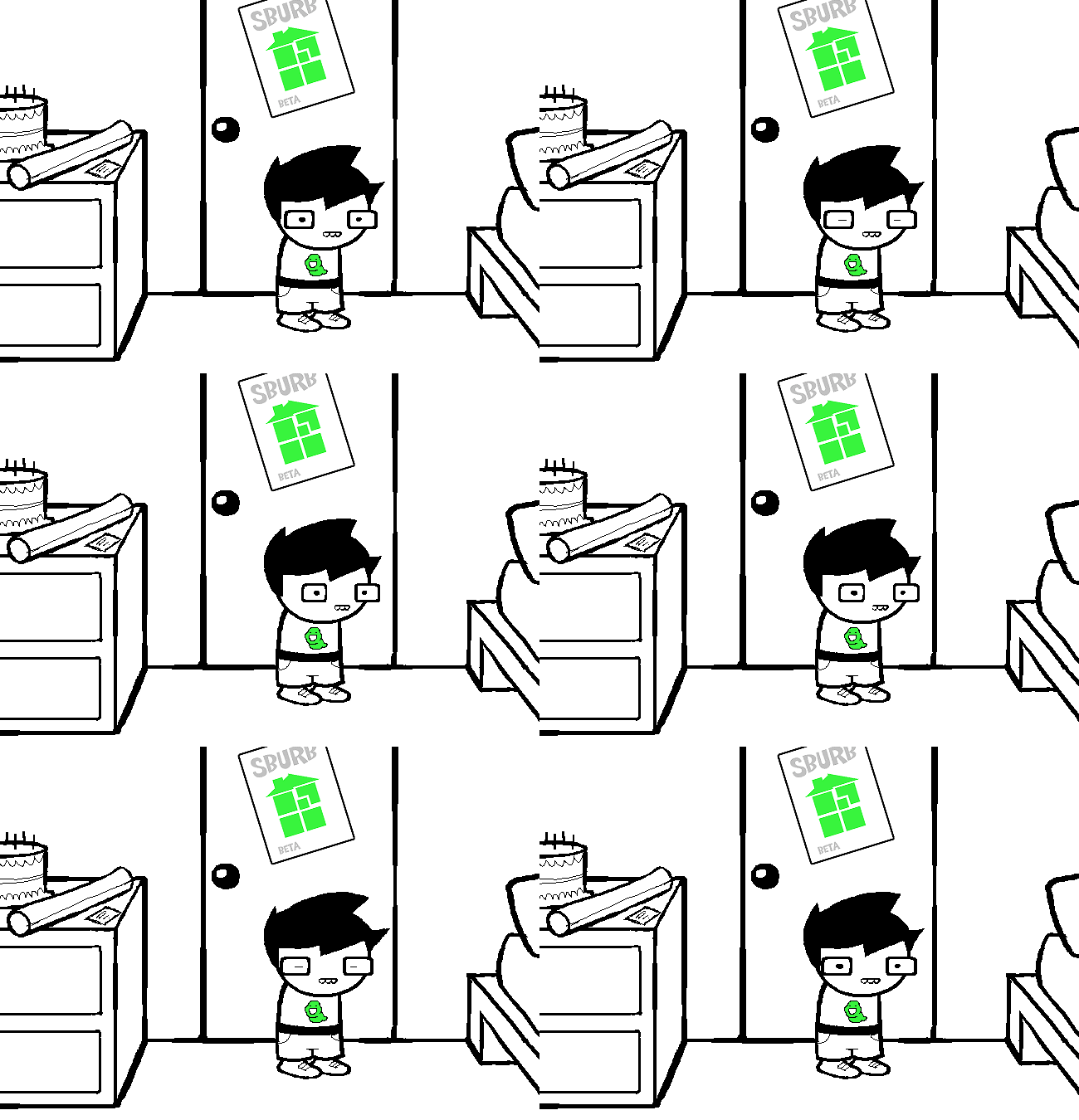
           Homestuck is a fairly good example of a story that uses these ideas Jenkins brings up. Homestuck is a webcomic that was started in 2009 by Andrew Hussie. It is a comic about a boy named John who plays video games with his friends and is tossed into a world of chaos where John and his friends meet multiple interesting characters along the way (worldbuilding). It is quite confusing and plots and themes often show up multiple times in the comic, almost everything has a meaning. Homestuck is told by a mixture of text, chat logs, pictures, flash animations, music and interactive play. Not only this but Hussie likes to throw in pop culture references and sections of older comics he has created within Homestuck. The fandom itself is a very lively bunch of people. There are multiple large Homestuck fan communities both in real life and on the Internet (spreadability). Multiple websites exist to help those who need events explained or theories discussed. There are even people who translate different dialects used in the comic (performance). There is also a vast majority of fan fiction and fan art that is created that helps gain outsiders interest (extractability). 
           There are many, many other fandoms that use these ideas Jenkins writes about. Shows like Supernatural, Sherlock and Dr.Who all share some aspects of transmedia story telling. (Here is an example of a popular piece of fan art that actually combines all three shows mentioned above)